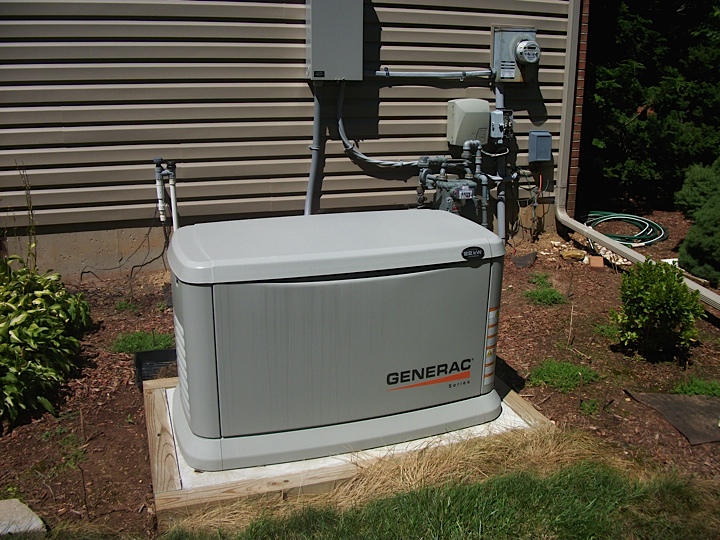
Complete Engineering Guide to Home Standby Generator Installations
Installing a residential standby generator is far more involved than setting an appliance on a patio. A permanent backup power system connects directly to two of the most critical infrastructures in your house: your main 120/240-volt electrical service entrance and your pressurized natural gas or liquid propane (LP) fuel supply. Every calculation—from conductor ampacity and ground-rod bonding to gas pipe internal diameter and regulator BTU capacity—must be executed accurately so the generator performs reliably under peak storm load.
At Home Generator Installations, LLC, owner Stephen O'Donnell draws upon more than 39 years of hands-on utility and electrical contracting experience across Bucks and Montgomery Counties. Instead of splitting responsibility between separate electrical and plumbing subcontractors, our team designs and installs the entire system under one roof.
1. Whole-House Coverage vs. Managed Essential-Circuit Coverage
Before selecting a generator model, we evaluate how your family uses electricity during an extended outage and inspect your main breaker panel, HVAC data plates, and well or sump pump ratings:
-
Managed Whole-House Standby Systems (18kW to 26kW Air-Cooled): Paired with a 200-amp service-entrance rated Automatic Transfer Switch (such as the Generac RXSW200A3), a whole-house installation backs up every circuit in your main electrical panel. By utilizing integrated load-shedding relays or Smart Management Modules (SMMs) on heavy 240V loads like secondary central air conditioners, electric ovens, or Level 2 EV chargers, a 22kW, 24kW, or 26kW generator can run an entire 2,500 to 4,500 sq. ft. home without overloading.
-
Essential-Circuit / Priority Load Systems (10kW to 14kW Air-Cooled): Paired with a 100-amp or 16-circuit load-center transfer switch, priority coverage isolates your most critical branch circuits into a dedicated emergency subpanel. Typical protected circuits include your gas or oil furnace blower, kitchen refrigerator, chest freezer, basement sump pump, 240V submersible well pump, microwave, septic grinder pump, medical equipment (CPAP, oxygen concentrators), Wi-Fi router, garage door openers, and key interior/exterior lighting circuits.
-
Large-Estate Liquid-Cooled Standby Systems (27kW to 60kW+): For larger estates in Newtown, New Hope, Doylestown, Blue Bell, or Lower Gwynedd with 400-amp electrical service (dual 200A panels), geothermal heat pumps, multiple 5-ton AC condensers, and heated pools or detached guest houses, we install automotive-style 1,800 RPM liquid-cooled Generac Protector Series generators capable of continuous commercial-grade duty.
2. Generator Sizing & Technical Specifications Matrix
Use the reference table below to compare the most frequently installed residential standby generator capacities, their running output on Natural Gas (NG) versus Liquid Propane (LP), fuel consumption rates, and typical home applications across Southeastern Pennsylvania. For a customized calculation based on your exact appliances, use our interactive Home Generator Installation Cost Calculator.
| Generator Size Tier |
Output (LP / NG) |
Max Amps (240V) |
Fuel Usage @ 50% / 100% Load |
Recommended Home Profile & HVAC Load |
| 10kW Compact Standby |
10 kW LP / 9 kW NG |
41.6 A / 37.5 A |
NG: 101 / 127 CFH
LP: 1.18 / 1.48 Gal/hr |
1,000–1,800 sq. ft. homes; 8 to 12 priority circuits (furnace, fridge, sump pump, lights, outlets; up to 2.5-ton AC). |
| 14kW Essential Plus |
14 kW LP / 14 kW NG |
58.3 A / 58.3 A |
NG: 189 / 256 CFH
LP: 1.68 / 2.56 Gal/hr |
1,500–2,500 sq. ft. homes; 16 priority circuits or managed 100A/200A service with 3-ton central A/C and well pump. |
| 18kW Managed Whole-Home |
18 kW LP / 17 kW NG |
75.0 A / 70.8 A |
NG: 194 / 278 CFH
LP: 2.06 / 3.16 Gal/hr |
2,000–3,000 sq. ft. homes; whole-house 200A transfer switch with load management on 3.5-to-4-ton A/C and electric range. |
| 22kW Whole-House Standard |
22 kW LP / 19.5 kW NG |
91.6 A / 81.2 A |
NG: 228 / 327 CFH
LP: 2.56 / 3.90 Gal/hr |
2,500–3,800 sq. ft. homes; our most popular Bucks & Montgomery County whole-house system covering 4-to-5-ton A/C, well pump, and sump pumps. |
| 24kW / 26kW High-Output Air-Cooled |
24–26 kW LP / 21–22.5 kW NG |
100.0–108.3 A (LP) |
NG: 235 / 348 CFH
LP: 2.75 / 4.15 Gal/hr |
3,200–5,000 sq. ft. homes; heavy electrical loads, dual HVAC zones, finished basements with ejector and sump pumps, and home offices. |
| 32kW–48kW Liquid-Cooled |
32–48 kW LP & NG |
133.3–200.0 A |
NG: 315 / 610 CFH
LP: 3.40 / 6.50 Gal/hr |
4,500–8,000+ sq. ft. estates and light commercial facilities with 400A dual-panel service, geothermal HVAC, and 1,800 RPM ultra-quiet operation. |
3. Natural Gas (PECO) vs. Liquid Propane (LP) Fuel Supply Engineering
One of the most common mistakes made by inexperienced installers is tapping an undersized house gas line without calculating total connected BTU load and pipe friction loss. A 22kW to 26kW standby generator requires up to 327,000 to 350,000 BTU/hr of natural gas under full electrical load—often more than your furnace, water heater, gas dryer, and cooktop combined!
Critical Gas Pressure & Meter Capacity Check
Standard residential natural gas service in Bucks and Montgomery Counties operates at low pressure (typically 5 to 7 inches of water column [W.C.], or roughly 0.25 PSI). If your existing gas meter is a standard 250 CFH diaphragm meter and your furnace (100,000 BTU), water heater (40,000 BTU), and new 22kW generator (327,000 BTU) run simultaneously during a January blizzard, an undersized meter or 1/2-inch pipe will starve the generator of fuel, causing the furnace flame to drop out or the generator to shut down on an under-speed/under-voltage fault.
How HGI Solves This: During your free on-site assessment, we inspect your gas meter badge rating, measure static and dynamic pressure with a digital manometer, size Schedule 40 black iron or underground polyethylene (PE) piping according to NFPA 54 / IFGC tables, and coordinate any required PECO gas meter upgrade (such as upgrading an AC-250 meter to a 425 CFH or 630 CFH meter) before commissioning.
4. Municipal Permits, Setbacks & NFPA 37 Clearance Compliance
Every municipality in Bucks County and Montgomery County enforces strict building, electrical, and zoning rules for permanent outdoor power equipment. We handle all permit applications, plot plans, load calculation sheets, and one-line electrical diagrams required by local code officials:
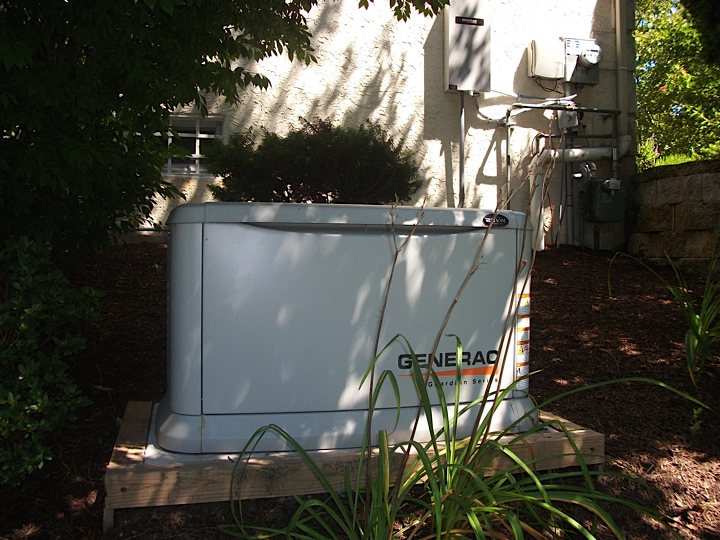
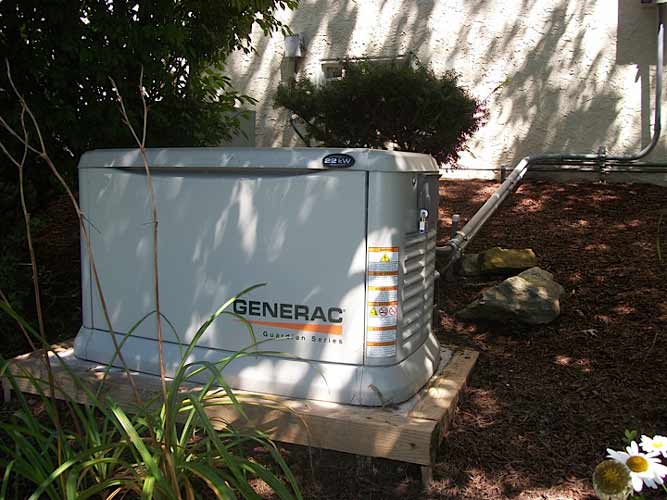
- NFPA 37 Exhaust & Opening Setbacks: The generator enclosure must be positioned at least 5 feet (60 inches) from any operable window, door, soffit vent, fresh-air intake, or ridge vent to prevent carbon monoxide infiltration into living spaces.
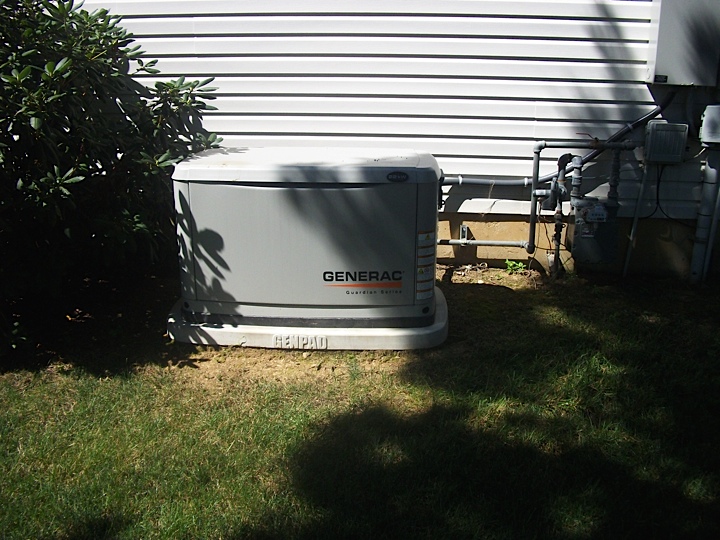
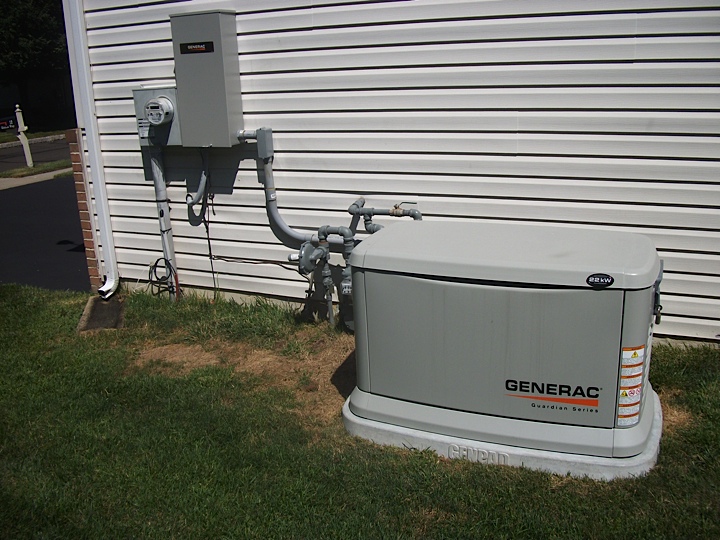
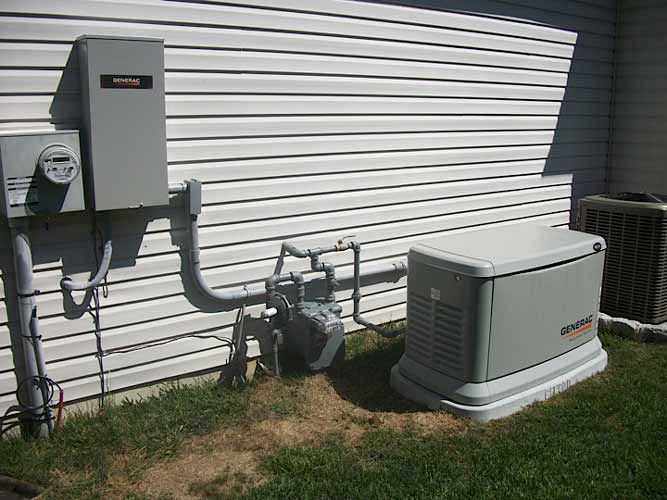
- Exterior Wall Clearance: Composite and aluminum sound-attenuated Generac enclosures tested to UL 2200 / NFPA 37 standards require a minimum 18-inch clearance from the back of the unit to the home's exterior siding or foundation wall, plus 36 inches (3 feet) of unobstructed clearance on the front and ends for technician maintenance access.
- Township Property Line Zoning Setbacks: Depending on your municipality (e.g., Lower Southampton Township, Northampton Township, Bensalem, Newtown, Warminster, Warrington, Doylestown, Abington, Upper Moreland, Horsham, or Lower Merion), side-yard and rear-yard zoning setbacks typically range from 5 feet to 15+ feet. We verify your specific township zoning code during our first visit.
- NEC Article 702 & Article 445 Electrical Standards: All installations include proper neutral-to-ground bonding configuration (floating neutral at the generator when paired with a 2-pole non-separately-derived transfer switch), outdoor emergency disconnect provisions, surge protection, and buried Schedule 40/80 PVC or rigid metallic conduit at code-mandated depths.
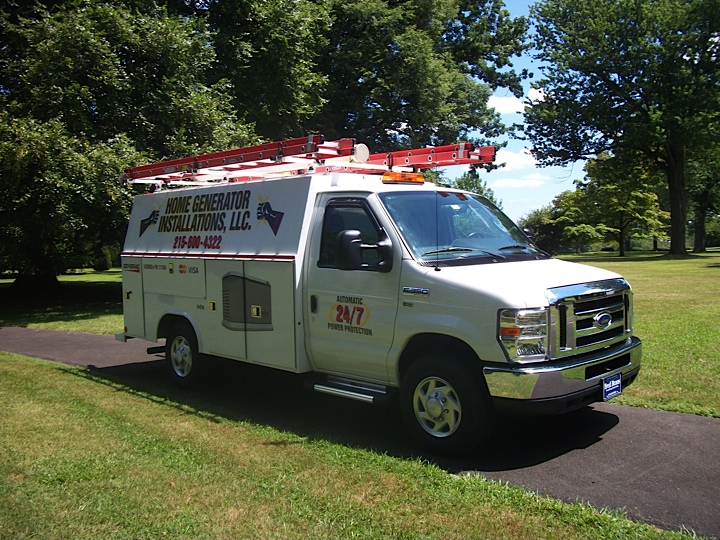
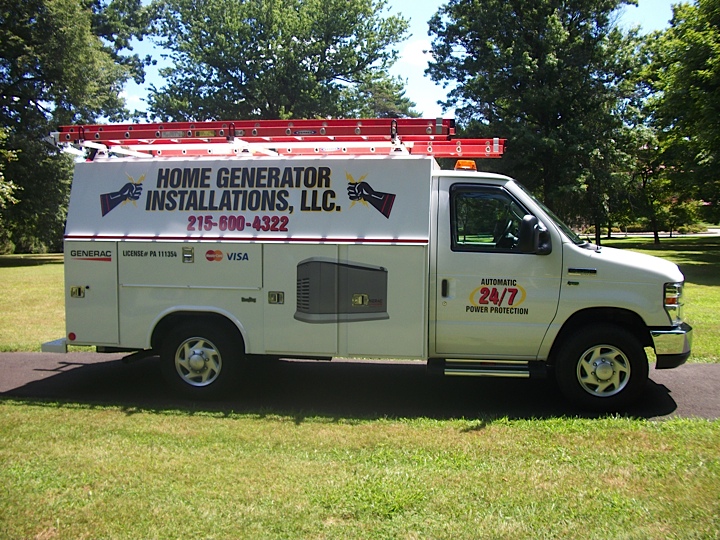
Our fully stocked mobile workshop brings all conduit, gas fittings, transfer switches, and testing instrumentation directly to your driveway.
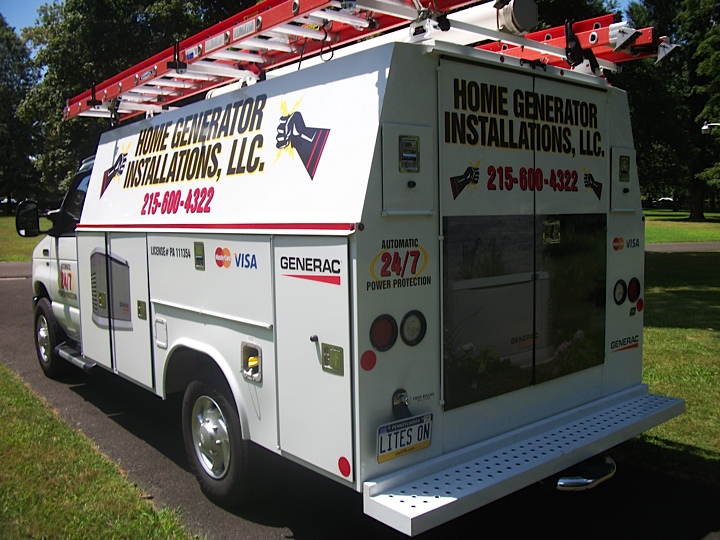
Look for our signature "LITES ON" Pennsylvania license plate across neighborhoods in Feasterville, Newtown, Doylestown, and Montgomery County!
Service Areas Across Bucks & Montgomery Counties, PA
From our headquarters at 148 E Street Road, Suite 111, Feasterville, PA 19053, Home Generator Installations, LLC provides rapid on-site estimates, turnkey installations, annual maintenance, and emergency storm service throughout Southeastern Pennsylvania:
Bucks County Communities Served
Feasterville-Trevose (19053), Lower Southampton, Upper Southampton, Southampton (18966), Churchville, Richboro (18954), Holland, Northampton Township, Bensalem (19020), Andalusia, Cornwells Heights, Langhorne (19047), Penndel, Hulmeville, Levittown, Bristol, Morrisville, Yardley (19067), Lower Makefield, Upper Makefield, Washington Crossing, Newtown (18940), Wrightstown, Warminster (18974), Ivyland, Hartsville, Warrington (18976), Warwick, Jamison (18929), Furlong, Doylestown (18901, 18902), Buckingham, New Britain, Chalfont (18914), Solebury, New Hope (18938), Plumsteadville, Perkasie, Sellersville, Quakertown, and Dublin.
Montgomery County Communities Served
Huntingdon Valley (19006), Bryn Athyn, Lower Moreland, Upper Moreland, Willow Grove (19090), Hatboro (19040), Horsham (19044), Abington (19001), Jenkintown, Glenside (19038), Elkins Park, Cheltenham, Wyncote, Oreland, Flourtown, Wyndmoor, Dresher (19025), Fort Washington (19034), Ambler (19002), Upper Dublin,Maple Glen, Spring House, Lower Gwynedd, Blue Bell (19422), Whitpain, Montgomeryville, Lansdale (19446), North Wales, Hatfield, Souderton, Plymouth Meeting, Lafayette Hill, Conshohocken, Norristown, King of Prussia, Collegeville, and Skippack.
Frequently Asked Questions About Whole-House Generators
How quickly does a Generac whole-house standby generator turn on during a power outage?
When utility power drops out, the automatic transfer switch senses the loss of grid voltage immediately. After a 5-to-10-second verification delay to ensure the outage is not a momentary utility flicker, the standby generator starts its engine, stabilizes at 3,600 RPM (60 Hz), and transfers your home's electrical load automatically—typically restoring power within 10 to 20 seconds without any manual intervention.
What size whole-house generator do most homes in Bucks and Montgomery Counties require?
For essential-circuit coverage (refrigerator, sump pump, furnace blower, well pump, and lighting) in a 1,500 to 2,500 sq. ft. home, a 14kW to 18kW standby generator is common. For full whole-house backup covering central air conditioning (3 to 5 tons), electric appliances, and all branch circuits in a 2,500 to 4,500 sq. ft. home, most homeowners select a 22kW, 24kW, or 26kW air-cooled Generac Guardian system. You can model your exact home load using our Home Generator Installation Cost Calculator.
Does Home Generator Installations handle both the electrical wiring and the natural gas or propane piping?
Yes. Owner Stephen O'Donnell brings over 39 years of experience in both the electric and gas utility fields. Unlike general contractors who subcontract plumbing or electrical phases, Home Generator Installations, LLC handles the entire turnkey installation—including pad preparation, natural gas or liquid propane piping, automatic transfer switch wiring, PECO meter upgrade coordination, and township permitting. Read more about our company background →
How often does a standby generator exercise itself and require maintenance?
Your generator can be programmed to run a brief 5-to-12-minute self-diagnostic exercise weekly, biweekly, or monthly at a reduced Quiet-Test RPM to circulate oil, charge the 12V starting battery, and verify controller readiness without transferring house loads. Preventive maintenance (synthetic oil change, oil filter, air filter, spark plugs, battery load test, and valve lash check) is recommended annually or after every 100 to 200 hours of continuous outage runtime. Explore our Maintenance & Repair Services or browse our 994 Technical Blog Articles for detailed guides.